This guide is published by Tukki, a U.S. immigration service provider that helps professionals and companies navigate work visas and green cards like the L-1A, H-1B, O-1A, EB-1A, EB-2 NIW, and more. Tukki offers dedicated immigration attorney support, visa eligibility assessments, and full case management from petition preparation through approval.
The L-1A is a U.S. nonimmigrant visa that allows multinational companies to transfer qualified executives or managers from a foreign office to an affiliated office in the United States. It can also be used to send an executive or manager to establish a new U.S. office. As an intracompany transfer visa, the L-1A is one of the most strategic options for global businesses expanding into the U.S. market and for the senior leaders moving with them.
Unlike the H-1B, the L-1A has no annual cap or lottery, it also allows dual intent, and offers a direct route to a green card through the EB-1C category for multinational managers and executives. This guide breaks down every L-1A visa requirement, the new office and blanket petition options, and covers costs, processing times, and the path from L-1A to permanent residency.
Who is eligible for the L-1A visa?
To qualify for the L-1A, both the employee and the employer must meet certain requirements. The L-1A is built around an intracompany relationship, so eligibility depends as much on the company structure as on the individual being transferred.
Employee requirements
The employee must have worked in an executive or managerial capacity for the foreign company for at least one cumulative year within the three years preceding the application. Time spent physically in the United States does not count toward this requirement. For example, if the employee was hired a year ago but spent one month on business trips in the U.S., only 11 months would be credited. They would therefore need to complete one additional month of qualifying employment abroad to meet the requirement.
The new position in the United States must also be in an executive or managerial capacity. This is the part of the petition USCIS scrutinizes most closely, so the role needs to be clearly defined around strategic decision-making and the management of people or functions. For a breakdown of what counts as a qualifying role, see our guide on L-1A qualifying positions.
Employer requirements
There must be a qualifying relationship between the foreign company and the U.S. entity (parent, branch, subsidiary, or affiliate).
Both entities must be actively doing business (during and after issuance of the L-1A), meaning the regular and continuous provision of goods or services.
For a full walkthrough of who qualifies and how the intracompany transfer works, see our guide on L-1A visa requirements.
L-1A visa duration, extensions, and benefits
The length of stay under the L-1A depends on whether the employee is transferred to an existing office or sent to establish a new one.
Initial approval: Up to three years for an existing company and one year for a new office
Extensions: Granted in increments of two years (see our L-1A visa extension guide for how renewals work)
Maximum stay: A total of seven years in L-1A status
Main benefits
The L-1A has no annual cap, which makes it more accessible compared to capped visas like the H-1B
It allows dual intent, meaning the visa holder may pursue permanent residency while in L-1A status
Dependents (spouse and children under 21) may accompany the visa holder under L-2 status, and spouses are eligible to work in the United States. For more on dependent work options, see our spouse work authorization guide
A clear pathway to permanent residency through the EB-1C category for multinational managers and executives, which is often faster than other employment-based green cards
L-1A visa documentation requirements
A strong L-1A petition requires detailed supporting evidence. While the exact documentation may vary depending on whether it is for an existing office or a new office, the following are typically expected.
For the companies (U.S. and foreign company)
Proof of qualifying relationship (articles of incorporation, stock certificates, organizational charts)
Evidence of active business operations in both the U.S. and abroad (annual reports, tax returns, financial statements, invoices, contracts)
Organizational charts showing the structure of the company and where the transferee fits
For the employee
Employment verification confirming at least one year of continuous qualifying employment abroad within the last three years
Detailed job description of the prior role abroad and the proposed U.S. role, showing executive or managerial duties
Resume, diplomas, or professional background materials (if relevant to support experience level)
Resumes, degrees, and payroll information for the subordinate employees of the beneficiary
Common USCIS pushback on L-1A petitions
USCIS often scrutinizes L-1A petitions, especially when it comes to proving the executive or managerial nature of the role. Common areas of pushback include:
Job duties
USCIS may argue that the role described sounds more like a specialized employee rather than an executive or manager.
Staffing levels
In smaller offices or new offices, USCIS may question whether the employee will truly manage people and functions, or perform day-to-day tasks.
Qualifying relationship
The agency may request more evidence to confirm the corporate relationship between the U.S. and foreign entities.
How to overcome it
Anticipating USCIS concerns and preparing strong evidence upfront is key. Some strategies include:
Detailed job descriptions
Clearly highlight strategic, decision-making responsibilities instead of operational or routine tasks. Use language that emphasizes management of people or functions, and provide a percentage of time spent on each job duty.
Organizational charts
Show direct reports, departments, or functions managed by the transferee.
Supporting letters
Provide internal company letters that outline the employee's leadership role, past achievements, and authority within the company.
Financial evidence
Demonstrate the U.S. company's capacity to support the executive or manager role, including revenue, investments, or staffing budgets.
If a petition draws a Request for Evidence (RFE), responding thoroughly and on time is essential. A well-documented initial filing is the best way to avoid one.
L-1A new office petitions
The L-1A "new office" petition is a special category within the L-1A visa designed for multinational companies that are not yet operating in the United States, but wish to establish a new presence. Under this framework, an executive or manager from the foreign entity is transferred to the U.S. to set up and lead the new office. Unlike regular L-1A cases, the new office petition requires the company to prove that it has secured premises, has a viable business plan, and can reasonably support an executive or managerial position within the first year of operations.
When the employee is being sent to open a new U.S. office, additional requirements apply, beyond the general requirements established above.
Employee requirements
The employee must have worked for the foreign company in an executive or managerial capacity for at least one cumulative year within the three years preceding the application.
The U.S. role must also be executive or managerial, with a clear plan for the employee to assume those responsibilities as the new office grows.
Employer requirements
A qualifying relationship must exist between the foreign company and the newly established U.S. entity
Physical premises for the new office, large enough to accommodate at least the existing employees in the U.S., must be secured before filing the petition
A realistic plan to support the executive or managerial role within one year of approval, including financial ability, business activity plans, and staff growth projections
A business plan detailing projected staffing and revenues for the next five years
The U.S. entity must be considered a "new office," meaning it has not been doing business in the United States for more than one year
Duration of stay
Initial approval: Limited to one year, given the need to demonstrate that the new office will become operational.
Extensions: After the first year, the company must provide evidence that the U.S. office is active and capable of supporting an executive or managerial position. Extensions are then granted in increments of two years.
Maximum stay: Also capped at seven years in total.
Additional documentation you need
Lease or proof of secured physical premises in the U.S.
Business plan, including financial projections and staffing plans for the first year
Evidence of financial capacity to support the new U.S. operation (bank statements, investment records, funding documents)
After the first year, the company must prove that it has grown sufficiently to sustain the executive or managerial role. This often requires evidence such as payroll records, organizational charts showing hired staff, contracts or client lists demonstrating business activity, and financial documents showing revenue or investments
For new offices, include projected hires with supporting evidence (such as job postings and the business plan)
USCIS pushback on L-1A new office cases
After the first year in a new office case, USCIS will carefully review whether the U.S. entity has actually grown as projected. If staffing, revenue, or client acquisition is not sufficient, they may deny an extension on the grounds that the role is not truly executive or managerial
Heavy scrutiny at the extension stage if growth projections are not met
Concerns that the initial business plan is overly optimistic or lacks sufficient financial detail
Questions about whether the physical office premises are adequate for the projected operations
Requests for proof that the U.S. entity is already engaging in meaningful business activity, not just existing on paper
Challenges to the employee's role if it appears too involved in day-to-day operational tasks rather than strategic leadership
How to overcome it
Submit a robust business plan with realistic milestones and timelines to show how the office will reach a level requiring an executive or managerial role
Provide evidence of early business activity, such as contracts, invoices, client agreements, or service and product launches
Document concrete steps taken to staff the U.S. office, such as job postings, recruitment processes, and initial hires
Include clear evidence of secured funding, whether through parent company investment, loans, or other financial backing
Highlight the employee's high-level decision-making authority with detailed job descriptions and internal support letters
Demonstrate that the physical office premises are sufficient for projected staff and business operations
Provide ongoing financial and operational reports to show steady growth toward sustainability
L-1A blanket petitions
The L-1A blanket petition is designed to simplify and speed up the process for multinational companies that frequently transfer executives and managers to the United States. Instead of filing a separate Form I-129 for each employee, the company can obtain a blanket approval that covers multiple related entities. Once the blanket petition is approved, qualified employees can apply directly for an L-1A visa at a U.S. consulate or embassy, without the employer having to go through a new USCIS petition for each transfer. For a side-by-side look at the two filing routes, see our guide on L-1 blanket vs individual petitions.
Company requirements
The petitioner and each of the qualifying organizations are engaged in commercial trade or services
The petitioner has an office in the United States that has been doing business for one year or more
The petitioner has three or more domestic and foreign branches, subsidiaries, and affiliates
The petitioner, along with the other qualifying organizations, meets one of the following criteria:
Has obtained at least 10 L-1 approvals during the previous 12-month period
Has U.S. subsidiaries or affiliates with combined annual sales of at least $25 million
Has a U.S. workforce of at least 1,000 employees
Benefits of the L-1A blanket
Faster process: employees can apply directly at the consulate, avoiding the need for USCIS to adjudicate each petition individually
Flexibility: makes it easier to transfer employees among various subsidiaries and affiliates
Broad coverage: once approved, the blanket petition allows multiple corporate entities to be included under the same authorization
Limitations
Not all companies qualify. The program is typically available only to large, established multinational organizations
Employees must still meet all individual L-1A requirements (qualifying employment abroad, executive or managerial role, and so on)
Consular officers still review each case to ensure eligibility, even under a blanket petition
USCIS pushback on L-1A blanket petitions
USCIS may closely examine whether the company truly meets the blanket eligibility thresholds (number of L-1 approvals, revenue, or workforce size)
Individual employee petitions under the blanket may still be questioned, particularly regarding whether the role is truly executive or managerial
Consular officers may request additional documentation even with blanket approval, delaying issuance
If the corporate structure is complex, USCIS may ask for more evidence to confirm the relationships among affiliates and subsidiaries
How to overcome it
Prepare detailed evidence that the company meets one of the blanket criteria (10+ approvals, $25M in sales, or 1,000+ employees)
For each employee, provide strong documentation of prior qualifying employment and clearly defined executive or managerial duties
Maintain updated organizational charts and financial records across all covered entities
Anticipate consular scrutiny by including internal support letters, contracts, and proof of business operations to reinforce eligibility
How to apply for the L-1A visa
The L-1A application process runs between the employer (petitioner) and the transferring employee. Here is what to expect from start to finish.
1. Confirm the qualifying relationship
Establish that the foreign company and the U.S. entity share a parent, branch, subsidiary, or affiliate relationship, and that both are actively doing business.
2. Document the employee's qualifying employment
Verify at least one cumulative year of executive or managerial work abroad within the past three years, and define the proposed U.S. role.
3. Prepare the petition and evidence
Compile organizational charts, financial records, detailed job descriptions, and supporting letters. For new office cases, add the lease, business plan, and funding evidence.
4. File Form I-129
The U.S. employer files Form I-129 with USCIS, including documentation that proves the qualifying relationship, the employee's prior qualifying employment, and a detailed description of the executive or managerial duties. For more on this form, see our Form I-129 guide. Employers can opt for premium processing for a faster response.
5. Wait for a decision
USCIS will approve, deny, or issue a Request for Evidence (RFE). Respond to any RFE thoroughly and within the deadline.
6. Apply for the visa or change status
After the petition is approved, the employee may apply for an L-1A visa at a U.S. consulate abroad. If they are already in the U.S. in another status, they may, in some situations, request a change of status without leaving the country. For the difference between these routes, see our guide on consular processing vs adjustment of status.
For companies that transfer staff frequently, the blanket petition route lets qualified employees skip straight to the consular step.
How much does the L-1A visa cost?
The total cost of an L-1A petition depends on government filing fees, employer size, and whether you choose premium processing. The petitioning employer pays L-1A fees.
Fee
Amount
Form I-129 filing fee
$780
Asylum Program Fee (employers with 25+ employees)
$600
Asylum Program Fee (small employers/nonprofits)
$300
Fraud Prevention and Detection Fee
$500
Public Law 114-113 fee (employers with 50+ employees and more than 50% in H-1B or L-1 status)
$4,500
Premium processing (Form I-907, optional)
$2,805
For a personalized cost and timeline estimate based on your visa type, check the pricing tool.
L-1A visa processing time and timeline
Processing times vary depending on USCIS workload and, for consular cases, the embassy or consulate. Premium processing is available for faster adjudication.
Processing type
Estimated timeline
Standard processing (Form I-129)
1–4 months (varies by USCIS service center workload)
Premium processing (Form I-907)
15 business days for an initial response
Blanket L-1 (consular)
Employee applies directly at the consulate, often the fastest route
With premium processing, USCIS guarantees an initial response within 15 business days. That response can be an approval, a denial, or a Request for Evidence (RFE). If USCIS issues an RFE, the 15-day clock restarts once you respond. To file for premium processing, the petitioner submits Form I-907. For current timelines by case type, see our L-1A processing time and fees guide.
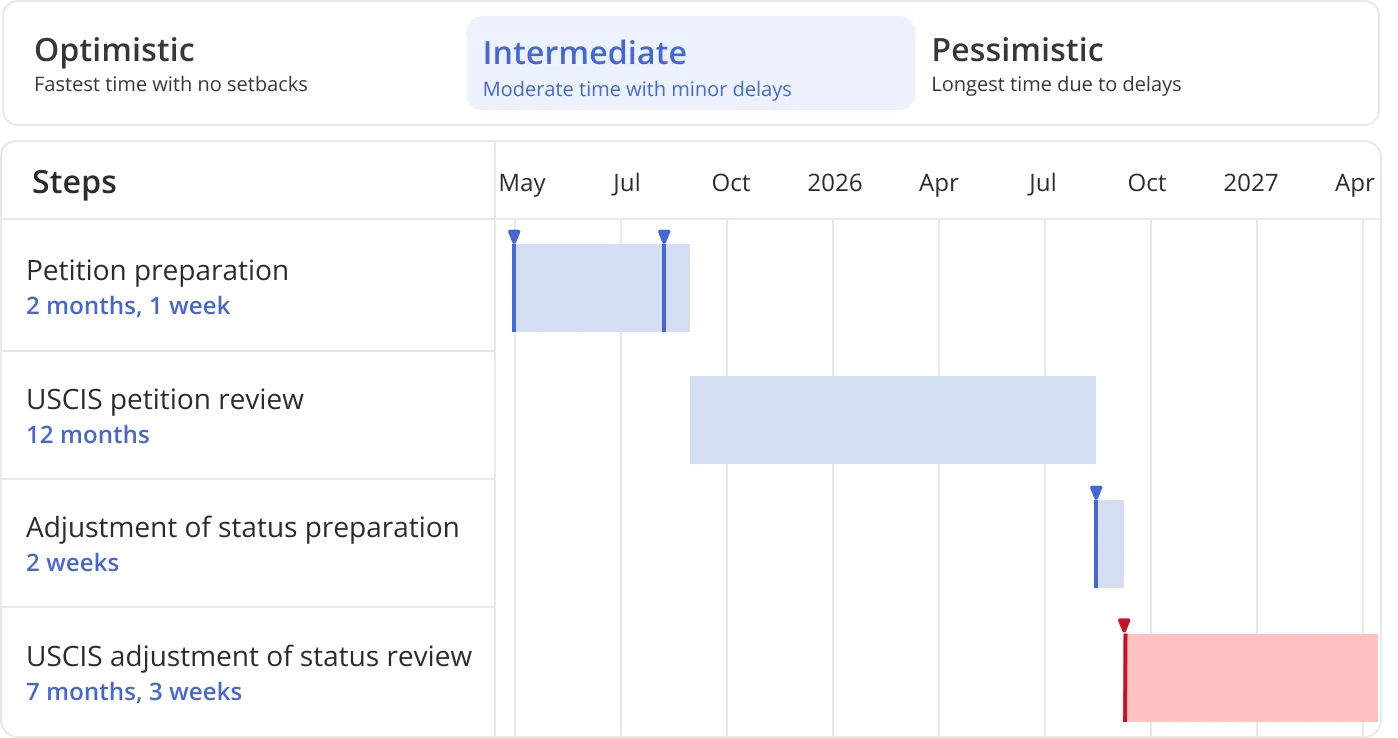
Can the L-1A lead to a green card?
Yes. The L-1A is one of the most direct nonimmigrant routes to permanent residency. Because it allows dual intent, you can pursue a green card while in L-1A status without jeopardizing your visa.
The natural pathway is the EB-1C category for multinational managers and executives. The EB-1C mirrors many of the L-1A requirements, such as the qualifying relationship and the executive or managerial role, and it does not require PERM labor certification, which makes it faster than most employment-based green cards. The employer files Form I-140 on the employee's behalf, and premium processing is available for the I-140 in the EB-1 categories.
Keep in mind that L-1B to L-1A conversion does not automatically make an employee eligible for the EB-1C. The managerial or executive role still has to be established on its own terms.
Final thoughts
The L-1A visa is a powerful tool for multinational companies seeking to expand operations in the United States by moving their senior leadership team. Its advantages, such as dual intent, no quota restrictions, and a direct route to a green card through the EB-1C category, make it especially attractive for executives and managers with long-term goals in the U.S.
That said, the requirements are strict, and USCIS carefully reviews petitions to ensure that the role is truly executive or managerial in nature. Work authorization is also restricted to the petitioning employer, and petitions may be denied if the evidence does not clearly demonstrate executive or managerial capacity, an active business operation, or a valid qualifying relationship.
Careful preparation and strong supporting documentation are essential for success. For companies with global growth in mind, and for leaders seeking to build their future in the U.S., the L-1A remains one of the most strategic visa options available.