This guide is published by Tukki, a U.S. immigration service provider that helps professionals and companies navigate work visas and green cards like the O-1A, O-1B, EB-1A, H-1B, EB-2 NIW, and more. Tukki offers dedicated immigration attorney support, visa eligibility assessments, and full case management from petition preparation through approval.
The O-1B visa is a U.S. work visa for individuals with extraordinary ability in the arts or extraordinary achievement in the motion picture or television industry. It's designed for creatives at the top of their game, whether you're a visual artist, performer, director, designer, writer, or any other kind of professional whose work lives in the creative world.
Unlike many other work visas, the O-1B doesn't require a minimum salary or a traditional employer. It also doesn't have an annual cap, and it allows you to work in the U.S. through flexible arrangements, including being sponsored by an agent. That makes it a strong option for freelancers and project-based artists.
To qualify, you'll need to demonstrate sustained national or international acclaim and show that your achievements have been recognized in your field through extensive documentation. That means meeting at least 3 out of 6 categories of evidence defined by USCIS (U.S. Citizenship and Immigration Services). But it's not just about checking boxes. What matters is crafting a narrative that positions you as a leading figure in your creative domain. This guide breaks down every O-1B visa requirement, walks through each criterion with examples and evidence strategies, and covers costs, processing times, and the path from O-1B to a green card.
What is the O-1B visa?
The O-1B is a nonimmigrant visa that allows artists and creatives with exceptional talent to live and work in the United States for a specific period of time. There are two types of O-1B categories:
O-1B (Arts)
For individuals in the arts, such as actors, musicians, dancers, visual artists, photographers, marketers, chefs, designers, directors, and writers, who have demonstrated extraordinary ability through sustained national or international acclaim.
O-1B (MPTV)
For professionals in the motion picture or television industry, including producers, editors, cinematographers, and others who have a record of extraordinary achievement in film or TV productions. The MPTV standard is higher than the general arts standard: you must show a degree of skill and recognition significantly above what is ordinarily encountered, to the point of being notable or leading in the industry.
The O-1B visa provides flexibility for professionals whose work doesn't always fit neatly into traditional job structures. Whether you're freelancing, working on a series of projects, or collaborating with multiple organizations, the O-1B allows for a variety of employment types, including contracts through a U.S. agent.
Unlike many other visas, it's not based on degrees or years of experience. It's based on impact and recognition. If you've built a creative career that's earned acclaim from experts, media, or industry organizations, the O-1B could be your path to working legally in the U.S.
Who can apply for the O-1B visa?
You don't need to be a celebrity or have a household name to qualify for an O-1B. What matters is that your work has made a mark and that others in your industry recognize it.
The O-1B is open to a wide range of creative professionals, from performers to behind-the-scenes talent. The key is showing that your achievements are extraordinary and that you've received recognition from respected peers in your field.
You might be eligible if you are:
An actor who's played lead or starring roles in major productions
A dancer or choreographer with invitations to perform or create for acclaimed companies or events
A musician or composer with press coverage, critical acclaim, or a strong record of performances
A visual artist or designer whose work has been exhibited, published, or commissioned by respected institutions
A writer or screenwriter with published work, festival selections, or contributions to successful productions
A film or TV professional (director, cinematographer, editor, etc.) with credits in critically acclaimed or commercially successful projects
A marketing professional whose campaigns have received industry awards, significant media coverage, or proven large-scale impact
An architect whose projects have been featured in leading publications, received prestigious awards, or been commissioned by recognized institutions
A UX designer whose work has shaped high-profile digital products, received industry recognition, or been presented at respected conferences
An interior designer whose projects have been published, awarded, or showcased by well-known firms, brands, or institutions
If your work has been seen, praised, or awarded, whether by critics, professional associations, or the media, and you continue to work in your field, you might be eligible. To see how the criteria apply in practice, read our guides on the O-1B visa for musicians and the O-1 visa for influencers and content creators. If you're unsure whether the O-1B fits your profile, try Tukki's Visa Match tool to compare options based on your background and goals.
Why choose the O-1B over other work visas?
The O-1B offers advantages that few other work visas can match for creative professionals. Here is what works in your favor and what to plan around.
Advantages:
No annual cap. Unlike the H-1B, there's no lottery or limit on the number of O-1B visas issued each year
No degree requirement. Your talent and recognition matter more than academic credentials
No minimum salary. You don't need to meet a government-set wage level to qualify
Flexible employment. You can work with multiple employers, or through a U.S. agent instead of a single company, which allows you to add more employers after the petition is filed
Fast processing. Premium processing is available, allowing for a decision in 15 business days
A strong step toward the EB-1A extraordinary ability green card, which has the option to self-petition without any employer involvement
Limitations:
High evidentiary burden. You must prove extraordinary ability with strong documentation and a clear narrative
Tied to your field. You must continue working in the same area of expertise you're recognized for
Dependents can't work. O-3 visa holders (spouse and children) can live and study in the U.S. but are not authorized to work
O-1B visa requirements
To apply for an O-1B visa, you don't need to meet every single criterion out there, but you do need to prove that you have extraordinary ability in the arts or extraordinary achievement in motion picture or television. Here's what that generally means.
You need a U.S. petitioner
This can be a company, organization, or agent who will sponsor your application. You cannot self-petition. An agent can file for performers or artists who work for multiple employers, which is common in the arts. For a deeper explanation of how the petition is filed, see our Form I-129 guide.
You must work in your field of acclaim
The work you plan to do in the U.S. must be directly related to the area where you've earned recognition.
You must meet at least 3 of the 6 USCIS criteria
Or show a major national or international award in your field.
You must include a detailed advisory opinion letter
This is a letter from a relevant U.S. labor union or peer group, giving input on your qualifications and the offered role. If no peer group exists, you can provide a letter from a U.S. expert in the field. For O-1B (MPTV), the advisory opinion must come from both a relevant labor union and a management organization.
You need a clear, cohesive narrative
The evidence must tell a story that positions you as a leader or rising figure in your creative field, not just someone who's doing their job well.
In short, it's not about fame, but about impact, recognition, and a body of work that stands out. Even if your career hasn't been in the spotlight, a well-prepared case with the right evidence can make a strong impression.
The 6 O-1B visa criteria: how USCIS evaluates extraordinary ability
To qualify for an O-1B visa, you must either show that you've received a major national or international award (like an Oscar, Emmy, or Grammy), or meet at least 3 of the 6 criteria below.
We'll walk you through each one: what it means, what kind of documentation is useful, common pitfalls, and ideas for how to strengthen your case if you're not quite there yet.
1. Lead or starring role in distinguished productions or events
What qualifies
USCIS looks at whether you've played, and will play, a lead or starring role in productions or events that have a distinguished reputation. This applies to both your past work and the projects you plan to do in the U.S. in the future. You need to show that your role was central or highly visible, and that the production itself was recognized in your field.
Important: Letters of recommendation do not qualify as evidence for this category. USCIS requires evidence such as critical reviews, advertisements, publicity releases, publications, contracts, or endorsements, and specifically excludes unpublished testimonial or recommendation letters from this list.
Documentation you need
Contracts or offer letters that describe your role.
Publicity materials (posters, websites, social media announcements).
Critical reviews mentioning your name and performance.
Media coverage of the event or production.
Festival programs, lineups, or invitations.
Evidence of commercial or critical success (box office, viewership, press).
Common pitfalls
Submitting projects that lack proof of recognition or quality.
Roles that are too minor or not clearly described.
Not showing how your contribution was leading or critical.
Relying on letters of recommendation to prove it.
How to strengthen it
Include visuals (such as flyers or photos) that show your billing.
Highlight metrics: large audiences, sold-out shows, streaming numbers, and similar.
Use quotes from critics or media to prove the reputation of the production.
Qualifying examples
Playing the lead or featured role in a theater, dance, or music production.
Having your work (film, design, or performance) presented at a major festival, biennale, or exhibition with significant press coverage.
Being the credited lead professional (director, choreographer, creative lead) in a production or campaign that received critical acclaim or large-scale media attention.
Serving as the principal architect or designer for a project unveiled by a prestigious institution, museum, or brand.
Headlining a concert, show, or cultural event with ticket sales, streaming metrics, or audience numbers showing commercial success.
Being listed as the main contributor in official programs, festival lineups, or publicity materials for high-profile events.
If you are not ready yet:
Get cast or booked in higher-profile projects.
Take on more visible roles, such as soloist or lead performer.
Collaborate with organizations that have public presence or prestige.
Gather press or third-party reviews after each show or exhibition.
2. Recognition in major media or trade publications
What qualifies
This category is about national or international recognition for your achievements, shown through coverage in major newspapers, magazines, trade journals, or other well-regarded publications, whether print, online, radio, or video. The article or segment can focus entirely on you, or it can highlight your contribution to a broader project or event, as long as your work is discussed in a meaningful way.
Documentation you need
Critical reviews of your work in recognized media outlets.
Magazine or newspaper features that mention your achievements.
Trade journal articles analyzing your contribution to a project or trend.
Online media coverage with proven reach or industry standing.
Radio or podcast transcripts with a focus on your career or output.
Common USCIS pushback
Submitting general press releases or self-published content.
Relying on outlets without showing their reach or credibility.
Including articles that mention you only in passing without context.
How to overcome it
Focus on coverage from outlets with large audiences or strong industry reputation.
Highlight circulation stats, readership numbers, or audience data when possible.
Include translations if the coverage is in another language.
Add context: if the article isn't entirely about you, explain your role in the story.
Qualifying examples
A feature article in a major national newspaper highlighting your work or project.
A profile or interview in a respected industry magazine referring to your work.
A trade journal analysis discussing your specific contribution to a trend, project, or innovation in your field.
Coverage of your work or a project in recognized online outlets with large readership.
If you are not ready yet:
Pitch your work to relevant media outlets.
Apply for festivals, showcases, or awards that generate press.
Collaborate with partners who have stronger media traction.
3. Lead, starring, or critical role for a distinguished organization
What qualifies
USCIS wants to see whether you've had, and will perform in, an important role such as a lead, star, or key contributor within an organization or company that has a strong reputation in your field. This could be an arts institution, production company, festival, gallery, or any professional body with notable impact or recognition. Your role doesn't have to be public-facing, but it should be shown as critical to the organization's success in some way.
Documentation you need
Letters of recommendation from directors, producers, or supervisors that explain your contributions play a key role in this criterion. USCIS notes that detailed letters from people with personal knowledge of your role are particularly useful, provided they explain your role, the organization's reputation, and the author's basis of knowledge in as much detail as possible.
Supplement these with:
Contracts, offer letters, or work descriptions outlining your role.
Internal records, project summaries, or media credits showing your involvement.
Evidence of the organization's reputation (press, awards, partnerships, scale).
Common USCIS pushback
Failing to show that the organization is well-regarded in the field.
Vague descriptions of your role, without proving its importance.
Using testimonials that lack specific examples or context.
How to overcome it
Include metrics (audience size, reach, influence) that demonstrate the organization's relevance.
Ask collaborators to write detailed letters explaining what you did and why it mattered.
Explain the institution's history, reputation, or major accomplishments if they aren't widely known.
Use media mentions or industry rankings to support the organization's standing.
Qualifying examples
Serving as the artistic director, principal dancer, or lead actor at a nationally or internationally recognized performing arts company.
Being the chief architect or lead designer at a firm featured in top-tier industry rankings.
Working as a creative director or senior strategist at a global marketing agency.
Holding a leadership role (head of department, senior curator, resident artist) in a museum, gallery, or cultural institution with international reputation.
Serving as the lead editor, producer, or cinematographer on projects for a major film studio, television network, or streaming platform.
Acting as the head of UX or design for a tech company whose products are widely adopted.
If you are not ready yet:
Take on more responsibility in the projects or organizations you're already part of.
Lead key initiatives that you can later tie to outcomes or impact.
Seek out opportunities in organizations that have a strong presence or media footprint.
Look for ways to contribute beyond your title. What you actually do can matter more than what your role is called.
4. Record of major commercial success or critical acclaim
What qualifies
This category focuses on whether your work in films, shows, exhibitions, performances, or other artistic outputs has achieved strong commercial results or critical recognition. The success must be significant and publicly documented, either through numbers (revenue, ratings, ticket sales) or third-party praise (reviews, awards, rankings). Importantly, the success needs to be tied to your contribution. It's not enough that the project did well. You need to show you were part of why it succeeded.
Documentation you need
Box office receipts or sales figures.
Viewership data (such as streaming stats or Nielsen ratings).
Rankings or charts (such as "Top 10," Billboard, or bestseller lists).
Articles in trade or general media noting commercial or critical success.
Awards or nominations received by the production, with your name linked to it.
Reviews from credible critics or media outlets.
Common USCIS pushback
Submitting general success data with no mention of your role.
Using internal or unverifiable numbers with no third-party validation.
Focusing on subjective metrics rather than facts such as ratings or ticket sales.
How to overcome it
Explain how your role contributed to the success (lead actor, creative director, soloist).
Provide third-party coverage that mentions you by name in relation to the success.
Add context: if the success was in a niche field, clarify what counts as "major" in that industry.
Include both commercial and critical reviews when possible, since they reinforce each other.
Qualifying examples
A film you acted in, directed, or contributed to grossing millions at the box office and receiving international press coverage.
A music album, single, or score you created charting on Billboard, Spotify Viral 50, or another recognized ranking.
A theatrical or dance performance you starred in or choreographed selling out multiple shows or touring internationally with strong reviews.
A book, script, or article you authored appearing on a bestseller list or being adapted into a major production.
An art exhibition, architectural project, or design installation you led that drew record attendance or was covered by leading media.
A digital product, app, or UX design you created reaching millions of users or industry honors such as the Webby or Red Dot Awards.
A TV show, documentary, or streaming project you produced, edited, or headlined ranking among the top-viewed programs on a major platform.
If you are not ready yet:
Aim to participate in projects that get exposure, distribution, or press.
Promote your work actively and strategically, since success can be built.
If you already have small wins, start tracking metrics: sales, attendance, clicks, ratings.
Collect reviews or audience testimonials. You might already have more impact than you think.
5. Significant recognition from experts, critics, or institutions
What qualifies
This criterion looks at whether recognized experts, critics, government agencies, or professional organizations have publicly acknowledged your achievements in the field. The key is that the recognition is significant, and that the source has authority or standing in your artistic domain. Letters of recommendation can be very effective here, but they must come from respected voices and clearly explain why your work stands out.
Documentation you need
Letters from industry leaders, renowned artists, or well-known critics.
Endorsements from respected cultural institutions or professional bodies.
Awards or recognitions from government entities or public agencies.
Testimonials from major organizations with detailed commentary on your contributions.
Each letter should include the writer's credentials and relationship to your work, explain your achievements and their significance, and stay detailed and specific, focusing on facts rather than general praise.
Common USCIS pushback
Submitting generic recommendation letters with no explanation of why the author is qualified.
Using testimonials that are vague or purely personal and don't explain why you are extraordinary.
How to overcome it
Choose letter writers who have national or international standing.
Provide background on the expert or organization (press mentions, roles, honors).
Include letters that reference specific projects, impacts, or innovations, and that detail your achievements and contributions.
Frame the recognition in the context of your broader influence: how your work matters in the field.
Qualifying examples
A detailed letter of recommendation from a highly respected expert in your field (an award-winning director, renowned curator, senior architect, or leading critic) that explains your contributions and why they stand out.
If you are not ready yet:
Start cultivating relationships with experts, curators, or collaborators who can later vouch for you.
Participate in programs or exhibitions that bring you into contact with respected voices.
When someone praises your work, publicly or privately, consider asking if they'd write a short testimonial.
Be intentional about showcasing your achievements so others are aware of your impact.
6. High salary or other substantial remuneration
What qualifies
This one is fairly straightforward: USCIS wants to see if you've earned a high salary or substantial compensation compared to others in your field. It's one way to measure your value and recognition in the industry. It doesn't necessarily mean millions, but the bar is relative. Your pay needs to stand out when compared to similar professionals in your geographic and artistic niche, ideally in the top 90th percentile compared to your peers in your geography.
Documentation you need
Contracts or offer letters showing your current or past compensation.
Pay stubs or invoices.
Bank statements or tax returns (in some cases).
Salary comparison data for your field and region (industry wage surveys, government data, union rates).
Common USCIS pushback
Not contextualizing the salary, when USCIS needs to know it's high relative to others.
Using unverifiable or inconsistent documents.
Quoting U.S.-based salary benchmarks if you're working internationally without explanation.
How to overcome it
Explain your country or market context.
Include documentation from credible sources (official wage data, trade publications, union scales).
If you're project-based or freelance, use project fees and show how they add up to substantial compensation.
If your work includes royalties or bonuses, include those too.
Qualifying examples
Salary or payroll through your employer.
Fellowships.
Grants.
High-valued equity.
Freelance work.
Bonuses or other types of compensation.
If you are not ready yet:
Let's be honest: this isn't the kind of category you can build in the short term unless you suddenly land a very high-paying gig. But if you're getting close:
Track and document all your income sources.
Make sure contracts or agreements clearly reflect your compensation.
If you're underpaid but working at a high level, consider whether other criteria might be stronger for you.
How much does the O-1B visa cost?
The total cost of an O-1B visa petition depends on government filing fees, whether you choose premium processing, and immigration attorney fees. The O-1B is filed on Form I-129, so its government fees match those of other O-1 petitions.
Fee
Amount
Form I-129 filing fee
$780
Asylum Program Fee (employers with 25+ employees)
$600
Asylum Program Fee (small employers/nonprofits)
$300
Premium processing (Form I-907, optional)
$2,965
Attorney fees vary depending on the complexity of your case and the firm you work with. For a general breakdown, see our guide on how much an immigration lawyer costs and our overview of U.S. work visa costs.
Keep in mind that preparing the petition, including gathering evidence, securing the advisory opinion, and drafting recommendation letters, often takes more time and effort than the filing itself. Budget for that as well.
For a personalized cost and timeline estimate based on your visa type, check the pricing tool.
O-1B visa processing time and timeline
How long it takes to get your O-1B visa approved depends on whether you file with standard or premium processing.
Processing type
Estimated timeline
Standard processing
4-8 months (varies by USCIS service center workload)
Premium processing
15 business days for an initial response
With premium processing, USCIS guarantees an initial response within 15 business days. That response can be an approval, a denial, or a Request for Evidence (RFE). If USCIS issues an RFE, the 15-day clock restarts once you respond. To file for premium processing, the petitioner submits Form I-907.
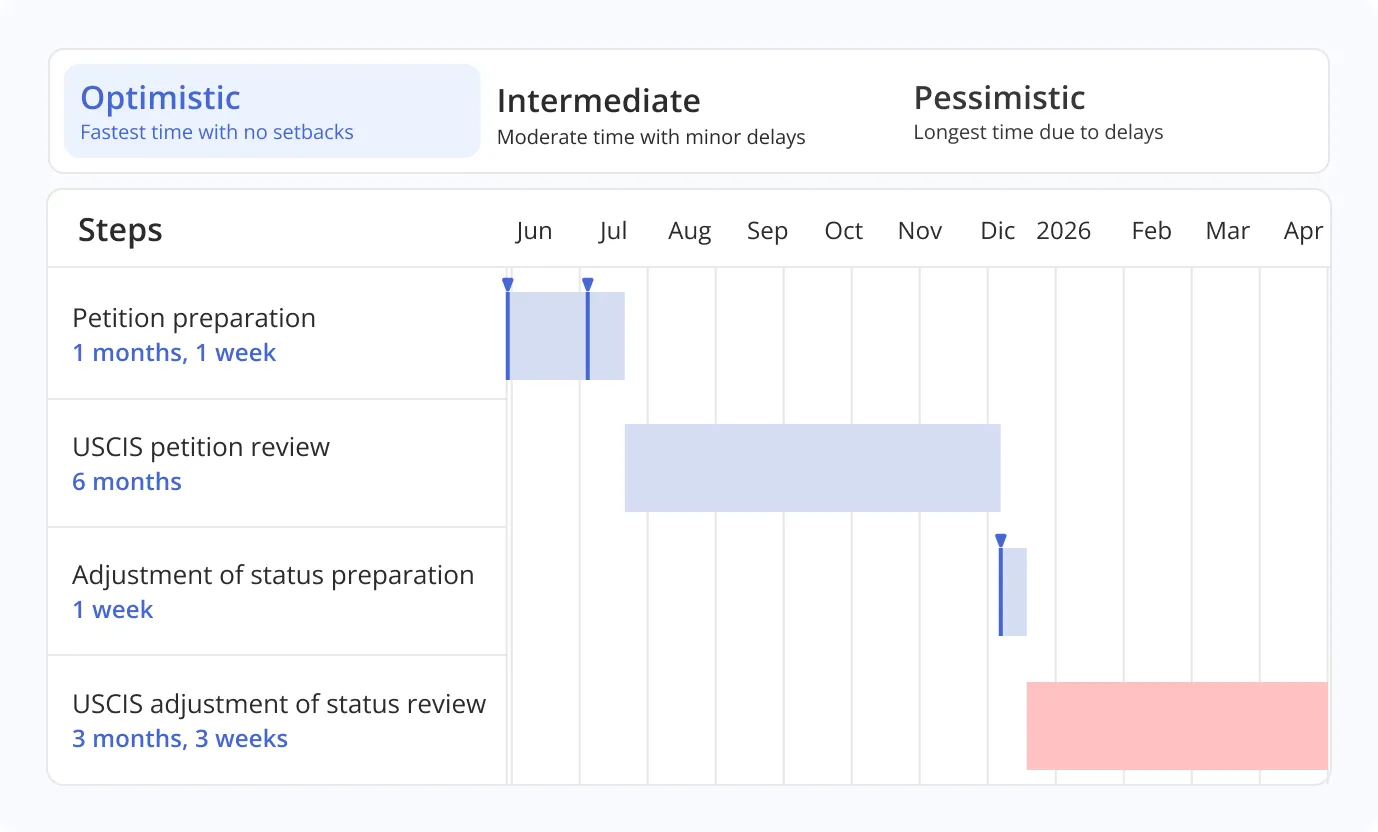
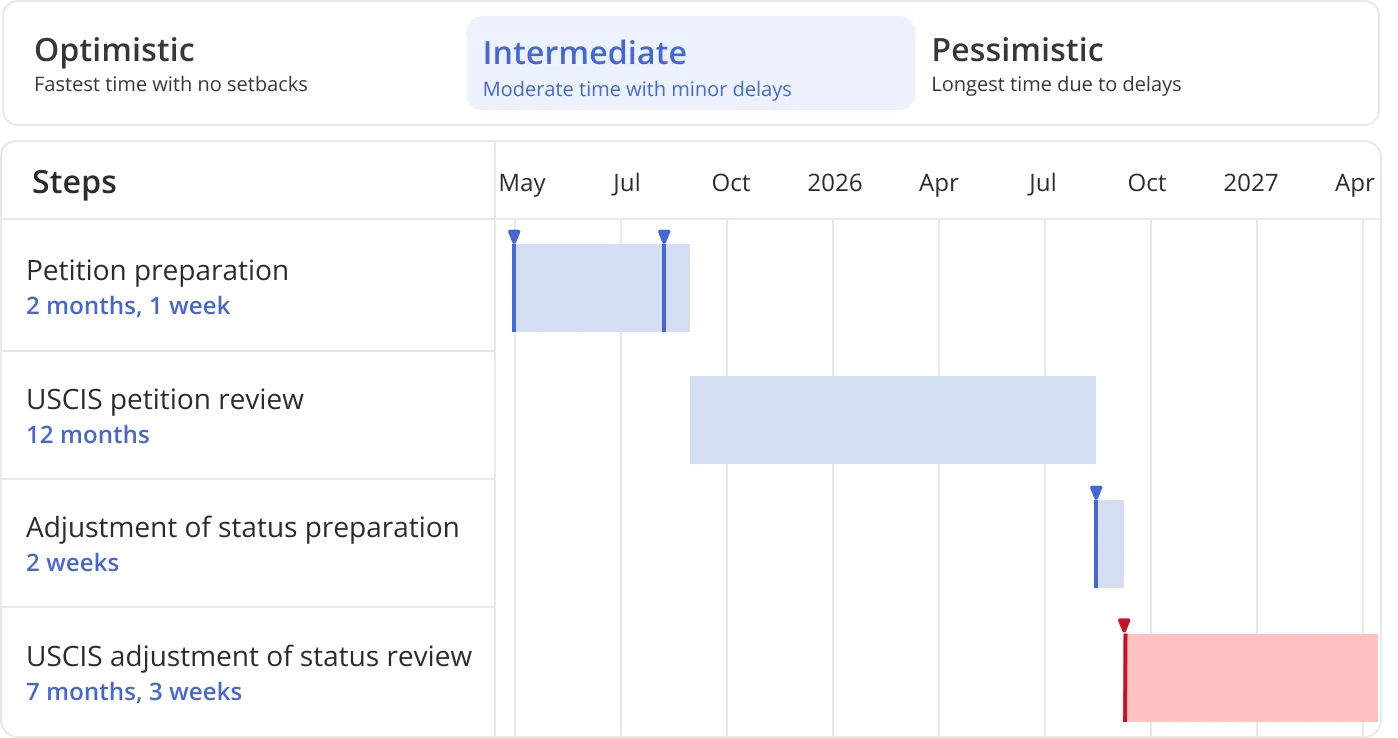
The total timeline from start to finish, including building your evidence portfolio, securing the advisory opinion, and preparing the petition, can take several months before you even file. Plan the documentation phase early, since gathering reviews, press, and letters is usually the longest part of the process.
How to apply for the O-1B visa
The O-1B visa application process involves several steps. Here is what to expect from start to finish.
1. Assess your eligibility. Review the 6 O-1B criteria and identify which ones you can support with documented evidence. You need at least 3, and meeting more strengthens your case. Use our O-1B eligibility assessment to get a quick read on where you stand.
2. Build your evidence portfolio. Gather documentation for each criterion you plan to claim: reviews, press coverage, contracts, programs, awards, sales or viewership data, and recommendation letters. This phase is typically the longest part of the process.
3. Collect recommendation letters. Aim for letters from people who can speak to your specific achievements, such as directors, curators, critics, or collaborators. Letters from credible figures outside your own organization carry more weight.
4. Find a U.S. petitioner. Your employer, your own U.S. company, or a U.S. agent must agree to serve as the petitioner and file on your behalf. Agent sponsorship is common for performers and artists who work across multiple projects.
5. Obtain the advisory opinion. Secure a written advisory opinion from the appropriate peer group or labor organization. For O-1B (MPTV), this must come from both a labor union and a management organization. Your immigration attorney usually coordinates this.
6. File the petition. Your petitioner files Form I-129 along with all supporting evidence. You can opt for premium processing for a faster response.
7. Wait for a decision. USCIS will approve, deny, or issue a Request for Evidence (RFE). If you receive an RFE, respond thoroughly and within the deadline.
8. Apply for a visa stamp (if abroad). If you are outside the U.S., schedule a visa interview at a U.S. consulate after your petition is approved. If you are already in the U.S. on another valid status, you may be able to change status without leaving the country through an adjustment of status or consular processing.
O-1B visa validity, extensions, and dependents
Initial validity and extensions
The O-1B is initially granted for up to 3 years. After that, you can apply for extensions in 1-year increments with no maximum limit, as long as you continue working with the same agent/employer and in the same project. Unlike the H-1B, which has a 6-year cap with limited exceptions, the O-1B lets you extend your stay as long as you remain active and recognized in your field.
Dependents
Your spouse and unmarried children under 21 can apply for O-3 dependent visas. O-3 holders can live in the U.S. and attend school, but they are not authorized to work. If your spouse needs work authorization, it is worth exploring whether they qualify for their own work visa or an employment authorization document through another pathway. For more on dependent options, see our guide on spouse work authorization.
O-1B vs. O-1A: Which extraordinary ability visa fits you?
The O-1A and O-1B are two branches of the same visa category, separated by field. The O-1A covers extraordinary ability in the sciences, education, business, and athletics, and uses 8 criteria. The O-1B covers extraordinary ability in the arts, or extraordinary achievement in motion picture and television and uses 6 criteria designed for creative work.
The classification follows your field. A musician, designer, or filmmaker files O-1B, while a scientist, founder, or athlete files O-1A. Some profiles blur the line. A creative technologist, or someone who works across business and the arts, such as a music producer running a company, may fit either category depending on how the role and evidence are framed. In those cases, the right classification is a strategic decision worth making with an immigration attorney. For a fuller comparison of the O-1 against the most common work visa, see our O-1 vs. H-1B guide.
Can the O-1B visa lead to a green card?
Not necessarily, since everything will depend on how each case is presented. The O-1B is a nonimmigrant visa, meaning it is temporary and can be one of the strongest stepping stones toward permanent residence for creative professionals, but it does not lead to a green card as easily as many people think.
Many of the same achievements you use for your O-1B petition, such as awards, published material about you, critical roles, and commercial success, can also support an EB-1A green card (Employment-Based First Preference for Extraordinary Ability).
The EB-1A covers extraordinary ability in the arts as well, does not require employer sponsorship or PERM labor certification, and allows you to self-petition. For more on what the EB-1A requires, see our EB-1A criteria guide and our EB-1A vs. O-1A comparison, which applies equally to O-1B holders weighing the green card step. But as we said, it all depends on how your attorney presents your case's narrative to USCIS.
For a broader look at the routes from O-1 status to permanent residence, read our guide on the O-1 visa to green card.
Tukki is a U.S. immigration services provider that helps creative professionals build and file their O-1B visa petitions and transition to green cards like the EB-1A, with dedicated immigration attorney support and full case visibility from petition prep through visa approval.
Final thoughts
The O-1B visa offers a unique opportunity for artists and creatives to bring their talent to the United States. But getting approved isn't just about being good at what you do. It's about being able to prove it in a way that fits the USCIS framework. That means understanding the criteria, gathering strong documentation, and crafting a narrative that shows your impact and recognition in the field.
You don't need to check every box or have international fame. What you do need is a clear record of excellence, evidence to back it up, and a strategy to present your case in the best possible light. Many talented individuals qualify without realizing it, because the bar for extraordinary is often more accessible than it sounds, especially when approached thoughtfully.
If you're unsure where you stand, or if you're just getting started, Tukki can guide you through the visa process step by step, with dedicated immigration attorney support from petition prep through approval.